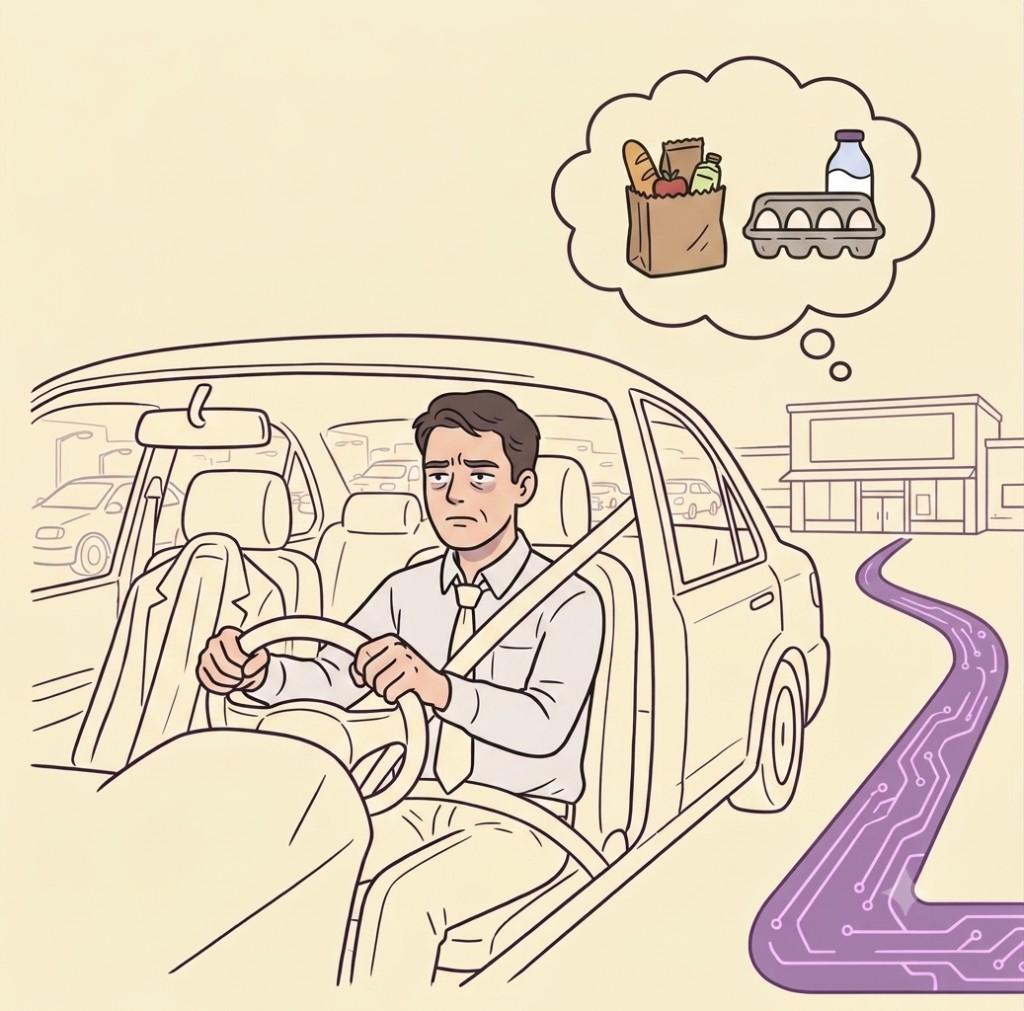
Here's a familiar loop: you think "I need to grab stamps" while you're in bed, half asleep. You think it again in the shower the next morning. You do not think it while you are physically standing in a store that sells stamps, at 2pm, with a cart and five free minutes. Two days later, you're out of stamps again and mildly furious at yourself.
This isn't a memory failure. Your memory did its job — the thought showed up, more than once. What failed was timing. The reminder arrived when you had no ability to act on it, and vanished the one moment you actually could.
The problem with a to-do list for errands
A flat list of errands assumes you'll remember to check the list at the exact right moment, in the exact right place — which is precisely the skill that's hardest to rely on. It puts the entire burden of timing back on you, the same executive function that struggled to hold the errand in the first place.
Reminders that show up where you are, not just when you set them
This is the single biggest lever for errands specifically, and it's the one most task apps skip entirely: a reminder tied to a place instead of a time.
GoMind AI's location-based reminders are built around exactly this gap:
Set it once, forget it safely. Add "buy stamps" and tag it to a location, or let it apply to any post office — you get nudged the moment you're actually near one, not at a randomly guessed time that may or may not line up.
No mental tab left open. Once it's logged, you don't have to keep re-remembering it "just in case" you pass the store — the app is holding that thread so you don't have to.
Works with how errands actually happen. Most errands don't get done because you scheduled them. They get done because you happened to be there and had the thought at the right second. This just makes sure you have the thought.
Gentle, not jarring. A nudge when you cross into range, not a barrage of alerts — the goal is a timely tap on the shoulder, not another notification to dismiss and forget.
Where else timing-based reminders help
"Take medication" tied to home, so it triggers when you're actually there to act on it, not at a fixed clock time you might be somewhere else entirely.
"Call the dentist" tied to your desk, for tasks that need you to be in a specific headspace or setup, not just a specific hour.
"Return the package" tied to your car or the post office, closing the loop between remembering and doing instead of leaving a gap for the thought to slip through.
The goal isn't to remember more. It's to make sure the reminders you already have show up exactly when they're useful — which, it turns out, has almost nothing to do with the clock and everything to do with where you are.