The idea of a "second brain" — offloading everything you're holding onto in your head into a system outside of it — is one of the most genuinely helpful productivity concepts to come out of the last decade. It's also one that quietly fails a lot of people at the exact moment it should be helping most: when what you need to offload isn't a task, but something more personal.
Passwords. A private worry you haven't told anyone yet. A health note you don't want surfacing in a work notification. The messy first draft of a feeling before you know what to do with it. These are exactly the things a second brain is supposed to hold — and exactly the things people hesitate to type into an app, because most notes apps were never built with the assumption that some of what you write is sensitive.
Why that hesitation matters
If part of your mental load doesn't feel safe to externalize, it doesn't get externalized. It stays in your head, taking up the same working memory a second brain was supposed to free up. The whole point of the system quietly breaks for the exact category of thought that was weighing on you the most.
This isn't paranoia. It's a completely reasonable response to living in a world where "your data" often means "someone else's product." Trusting a tool with your actual mind is a bigger ask than trusting it with your grocery list, and it deserves to be treated that way.
Building a mental space that's actually private
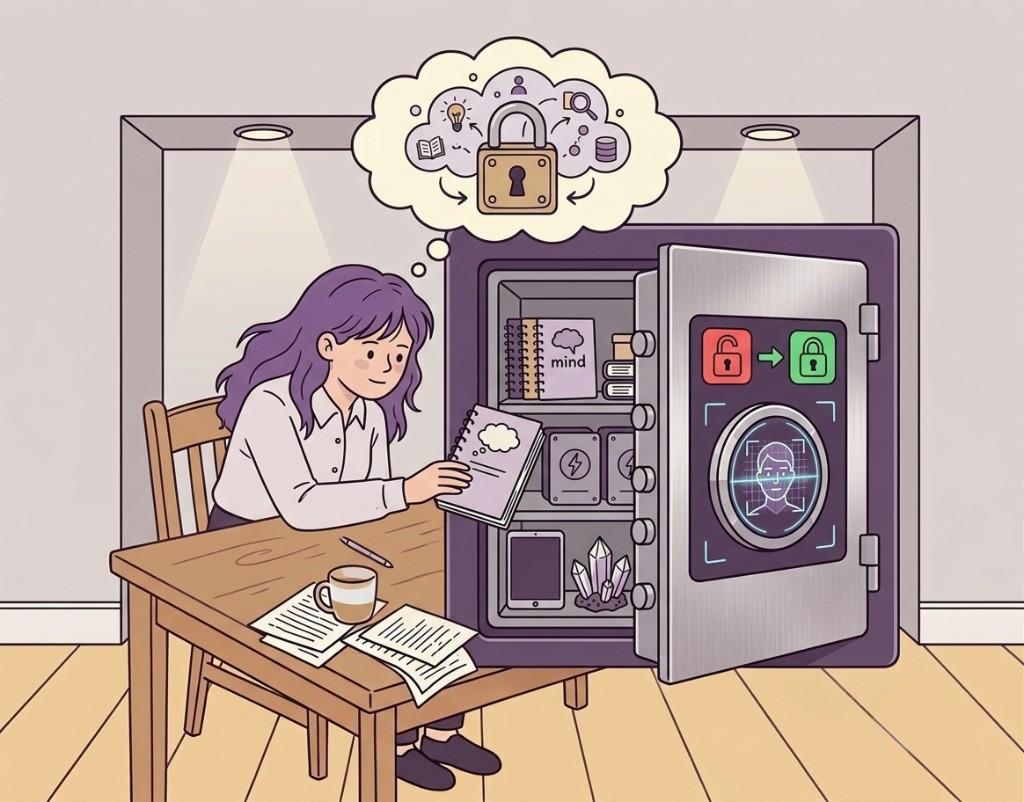
GoMind AI's Hub was built specifically for this — a separate, protected space inside the app for the things you want to hold onto without broadcasting them anywhere:
AES-256 encryption, the same standard used to protect financial and health data, applied to your private notes and password storage — not an afterthought bolted on later.
A biometric lock on the Hub itself, so even someone holding your unlocked phone doesn't have casual access to the part of the app that holds your most personal entries.
No ads, ever, which matters more than it sounds — an app that makes money from your attention has a structural incentive to mine what you type. One that doesn't, doesn't.
Separation from the rest of your workflow. Your task list and your private Hub live in the same app but not the same space, so the sensitive stuff isn't sitting one accidental tap away from a shared calendar view.
What actually goes in a protected space
Passwords and account recovery notes you don't want floating in a plain-text file.
The unfiltered version of a hard day, before you've decided how — or whether — to talk about it with anyone.
Health or medication notes you want tracked but not visible to anyone glancing at your screen.
Half-formed ideas you're not ready to defend yet, personal or otherwise.
A second brain only works if you trust it enough to actually use it for the hard stuff, not just the easy stuff. Privacy isn't a feature bolted onto productivity. For anyone close to burnout, it's the thing that decides whether the system gets used at all.
If anything in this piece feels close to home and you're carrying more than a to-do list can hold right now, it's worth talking to someone you trust or a mental health professional — a private notes app is a tool, not a substitute for support.