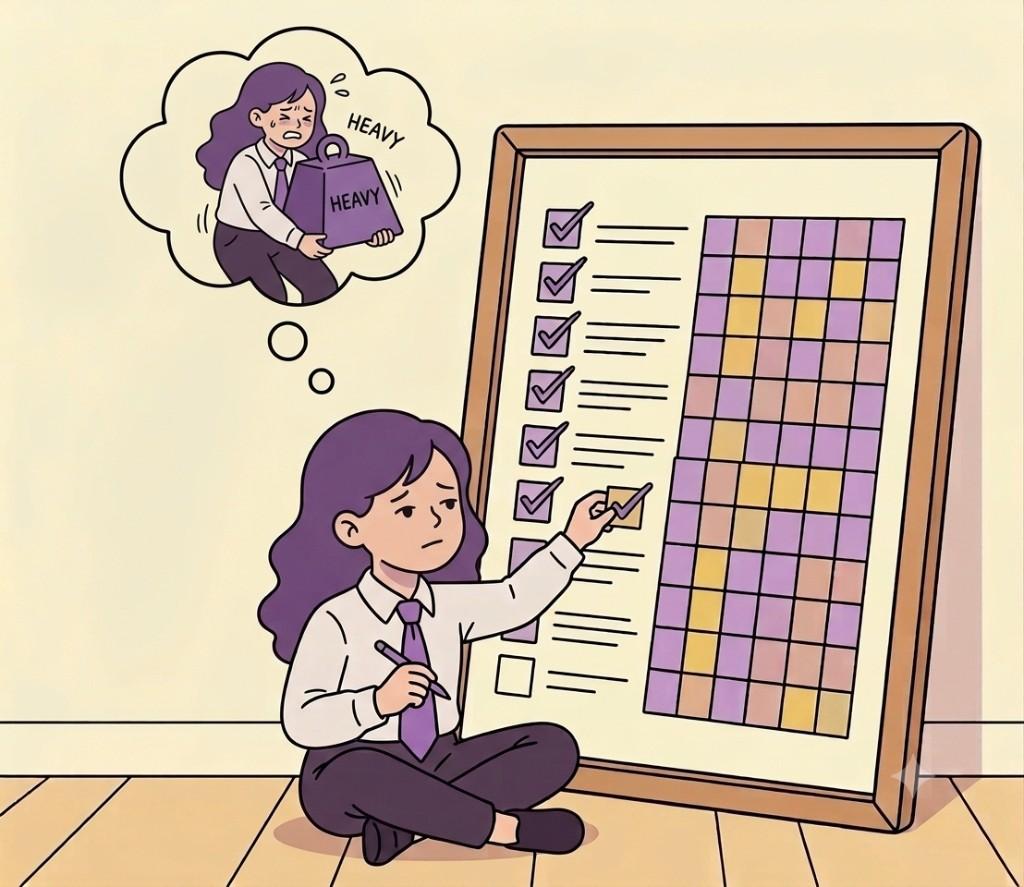
There's a specific, small relief in checking a box that has nothing to do with the task itself. You can feel it on something as trivial as "buy milk." The task was never hard — the relief comes from somewhere else: your brain finally getting to stop holding onto it.
That's not a coincidence, and it's not just a nice feeling — it's how working memory actually operates. An open task your brain hasn't confirmed is "handled" stays active in the background, quietly consuming attention even when you're not thinking about it directly. Psychologists call this the Zeigarnik effect: unfinished things intrude on your thoughts more than finished ones. A checklist doesn't just track your progress. It tells your brain, explicitly, that it's allowed to let go.
Why writing it down beats remembering it
Holding a task in your head "so you don't forget" is one of the most exhausting, least effective things you can do with working memory. It's not designed to be a long-term storage system, and using it that way is a constant low-grade tax — the mental equivalent of leaving fifteen browser tabs open. Externalizing it, even onto a scrap of paper, does something remembering alone can't: it lets your brain stop rehearsing the task just to keep it from disappearing.
This is also why huge, vague tasks feel so much heavier than they should. "Plan the event" has no obvious stopping point, so your brain can't ever confirm it's done — there's no box to check. Break it into "book the venue," "send invites," "confirm catering," and each one becomes something your brain can actually close.
Where small habits fit into this
Momentum doesn't come from ambition. It comes from evidence — your brain needs proof, repeatedly, that starting something doesn't have to be hard. A habit with too much friction (a 45-minute workout when you haven't moved in a week) rarely survives contact with a low-energy day. A tiny version of it (two minutes of stretching) almost always does, and it's the tiny version that actually builds the pattern your brain starts to trust.
How GoMind AI supports both at once
AI checklist generation turns an intimidating, vague task into a set of small, checkable steps automatically — so you get the relief of closing loops without having to do the breakdown work yourself first.
Voice-first capture for the moment a task occurs to you, so it gets externalized immediately instead of living in your head "just for now," which is usually how it gets forgotten.
Visible, satisfying progress when you check something off — a small, immediate signal that the loop is closed, not just a line quietly disappearing.
Habit tracking built around small, repeatable actions, not ambitious streaks that snap the first time life gets in the way.
Starting small, on purpose
Pick a version of the habit so easy it feels almost silly — one pushup, one paragraph, one glass of water.
Break any task with no obvious "done" point into ones that do have one.
Write things down the moment they occur to you, not when it's convenient — the delay is where they get lost.
Let checking the box be the reward. It's not nothing. It's your brain finally being told it can stop holding on.
You're not lazy for needing things broken down. You're working with a brain that needs proof of closure to actually relax — and that's a solvable problem, not a character flaw.