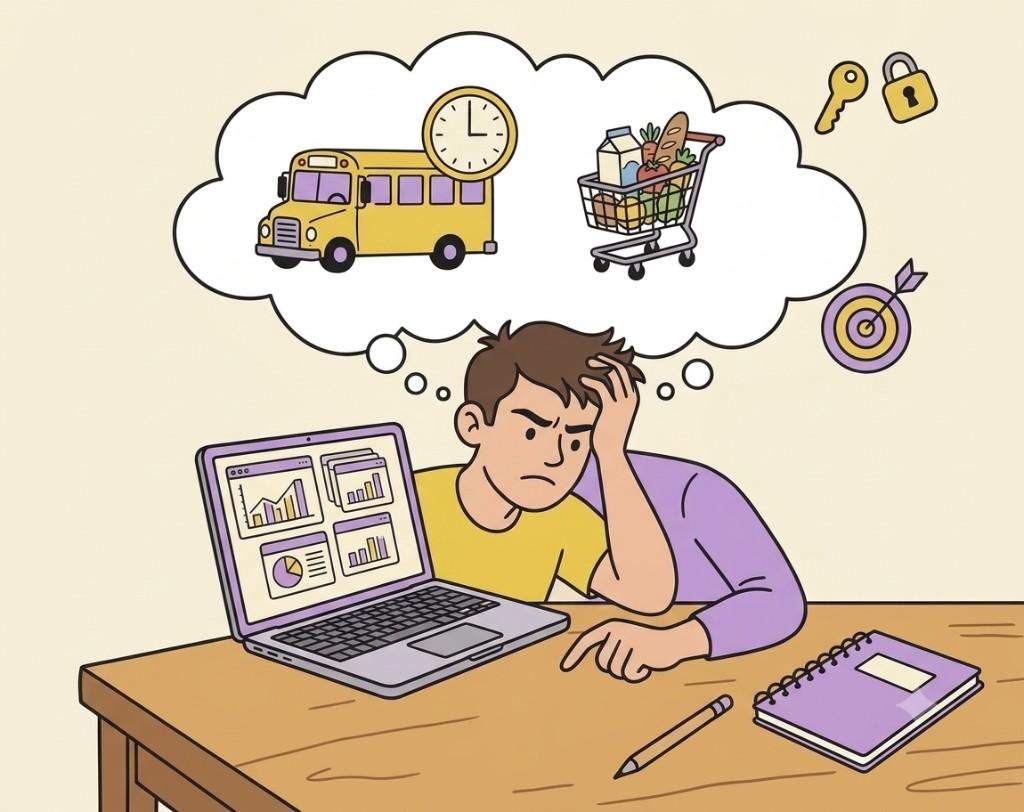
Nobody warns you that the exhausting part of a busy day isn't usually the work. It's the deciding. Which of your six open tabs to deal with first. Whether that email needs a reply today or can wait. Whether to check your calendar app or your notes app or the sticky note on your monitor to remember what you were supposed to do at 2pm. By the time you've actually picked a task, you've already spent the mental energy you needed to do it well.
This is decision fatigue, and it compounds in a very specific way: it's not one big decision draining you, it's dozens of small, invisible ones — made worse every time your information lives in a different place than the decision you need to make about it.
Scattered systems are the hidden tax
Think about how many apps a normal day touches: a calendar, a to-do list, an email inbox, a notes app for the thing you don't want to forget, maybe a separate habit tracker. Each one is fine on its own. Together, they force you to be your own project manager — constantly switching context, re-remembering what's where, re-deciding what matters right now. That switching cost is real, and it's the thing that quietly wrecks an afternoon before you've done anything wrong.
Reducing the sorting, not just the list
Most productivity advice tells you to simplify your list. That's true but incomplete — the list was never really the problem. The problem is you're the one doing all the sorting, every single time, from scratch.
GoMind AI was built around collapsing that sorting work rather than handing you a prettier place to keep it:
One place for tasks, habits, calendar, notes, and reminders, so you're not reconstructing your day from five different sources before you can even start it.
AI-filtered email, which quietly separates what actually needs your attention today from what can wait, instead of leaving your inbox as one more inbox of decisions.
AI Mode that looks at what's already on your plate and helps prioritize it — so "what should I do next" stops being a question you have to answer alone, every time, all day.
Manual Mode for when you'd rather see everything laid out and choose yourself, without AI suggestions in the way. Overwhelm isn't the same for everyone, and some days control feels better than automation.
Small ways to lower the tax today
Do one weekly sort, not twelve daily ones. Batch the "where does this go" decisions instead of making them fresh every time something comes in.
Notice when you're app-switching to find information, not to act on it. That's dead time, and it adds up faster than people realize.
Let go of remembering. If you're holding a task in your head "just in case," write it down the second it occurs to you — the holding is the tiring part, not the task itself.
You're not bad at making decisions. You're making too many of the wrong kind — the ones about where to look, not what to do. Fix that, and the actual work gets a lot easier to start.